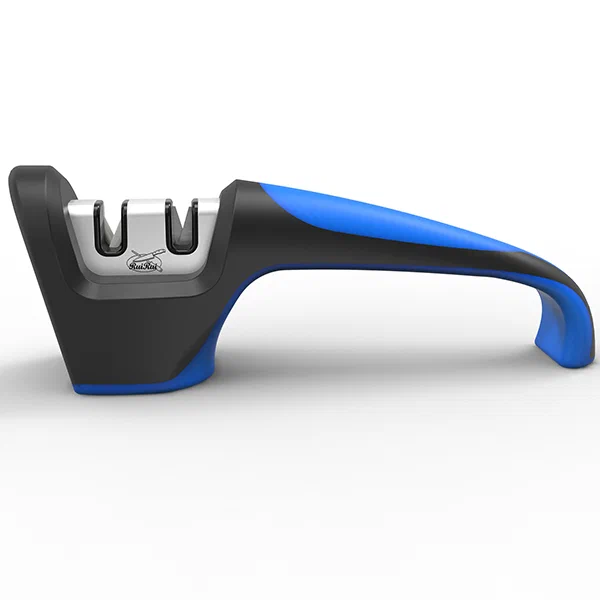
If you are a kitchenware distributor or retail buyer sourcing private-label pull-through sharpeners, you already know the pain: inconsistent carbide and ceramic edges, unclear bulk pricing, and unreliable monthly capacity can quickly erode your margins and damage your brand. This guide is written for the awareness stage. It helps you build a supplier evaluation framework focused on direct factory supply, competitive bulk pricing, and stable monthly production capacity.
Table of Contents
Introduction
If you are a kitchenware distributor or retail buyer sourcing private-label pull-through sharpeners, this scenario may sound familiar. You receive a batch of dual-slot sharpeners: carbide for coarse sharpening, ceramic for honing. Samples performed well. But a few weeks after shelf placement, end customers start complaining: “It doesn’t sharpen anymore,” “The ceramic slot chipped,” “My knife gets duller every time.” Returns climb, customer service costs rise, and your private-label launch is put on hold. The problem is rarely whether a factory exists. It is whether you chose a trading company or a direct manufacturer with stable monthly capacity and competitive bulk pricing. This article does not push you to place an order. Instead, it helps you at the awareness stage build a supplier evaluation logic that protects your private-label investment.
Direct Factory Supply and Stable Monthly Capacity: A Deep Dive
At the awareness stage, buyers often focus on unit price. But for kitchen knife accessories, which are repeat-purchase products, the real profit driver is total sourcing risk. A pull-through sharpener looks simple: housing, carbide blades, ceramic blades, spring, non-slip base. Yet the carbide blade angle, ceramic slot support structure, and spring pressure consistency directly affect end-user feel and knife life. If your supplier is a trading company, it usually cannot control these key processes. When batch variation appears, it can only offer replacements, not correct the root cause.
Direct factory supply creates commercial value in three ways. First, bulk pricing becomes more transparent. A factory can break down costs by material, slot count, and packaging method, rather than adding layers of markup on a finished product. Second, stable monthly capacity means replenishment is predictable. For distributors, a stockout during promotion season costs far more than saving a few cents per unit. Third, customization responds faster. Private label requires LOGO, color box, manual, barcode, and hang tab. A direct factory can integrate these into the same quality control system. Stable monthly capacity is not a slogan. It determines whether you can promise delivery to retail clients and whether end-user repurchase can continue.
2-Stage Kitchen Sharpener
B2B Purchasing Guide and Common Mistakes
When evaluating pull-through sharpeners, separate material combination from use case. Carbide and ceramic are not interchangeable; they have different roles. Carbide restores dull edges. Ceramic hones and polishes. The following comparison can support your internal purchasing discussion.
Dimension
Carbide Slot
Ceramic Slot
Carbide + Ceramic Dual Slot
Material Durability
Good for frequent coarse sharpening, relatively impact-resistant
Good for honing and polishing, but more brittle
Clear division of labor, more balanced overall life
Initial Cost
Medium
Medium
Slightly higher, but can reduce after-sales cost
Maintenance Cost
Needs protection from debris and rust
Needs protection from chipping, keep clean
Maintain each slot separately
Best Use Case
Quickly restore dull knives
Daily maintenance and fine edges
All-in-one private-label set
3 Details Buyers Most Often Overlook
Blade angle vs target market knives. Many buyers only confirm “dual slot” but ignore 15° vs 20° compatibility. A mismatch makes end users think the knife is “duller after sharpening,” leading to batch returns. Specific compatibility requires testing per market, [actual test data to be added].
Ceramic slot anti-chipping and debris clearance. Ceramic is hard but brittle. If slot support, spring pressure, or debris exit is poorly designed, chipping occurs during transport and daily use. Ask the supplier for a slot structure diagram and useto compare force and cleaning paths.
Private-label compliance and packaging consistency. Manual language, warning labels, color box barcode, retail hang tab, MOQ, and replenishment cycle all affect shelf speed. At the awareness stage, comparing only FOB price often leads to revision fees, sampling fees, and stockout costs later.
How to Select a Reliable Pull-Through Sharpener Supplier
Separate “can supply directly” from “can supply directly and stably.” First, supply chain stability: ask for monthly capacity proof, source of carbide and ceramic blades, whether key processes are in-house, and peak-season scheduling rules. A factory with stable monthly capacity usually has documented production planning and raw material safety stock. Second, quality control: ask for incoming material inspection, in-process inspection for blade angle and spring pressure, and finished product sharpening tests. Third, customization flexibility: can they handle private label LOGO, custom packaging, and mixed-material slot configurations without long lead times? For B2B buyers, the best supplier is not the one with the lowest quote, but the one that can repeat the same quality month after month. If a supplier cannot provide verifiable capacity and QC records, treat that as a warning sign.
Conclusion
At the awareness stage, your goal is not to find the cheapest pull-through sharpener. It is to understand which supplier model protects your private-label investment. Carbide and ceramic dual-slot sharpeners can deliver strong repurchase if blade angles, ceramic support, and spring pressure are consistent. Direct factory supply with competitive bulk pricing and stable monthly capacity reduces returns, protects your retail delivery promises, and makes private-label scaling realistic. Start by requesting capacity proof, QC flow, and customization samples. The right China manufacturer will welcome that scrutiny.