How to Choose a Survival Knife Sharpener for OEM Outdoor Brands
Choosing a survival knife sharpener for OEM outdoor brands starts with your blade mix, not the price list. This guide covers abrasive selection, integrated fire starter and whistle decisions, spec-sheet checkpoints, MOQ tiers and CE/RoHS documentation so you can brief a factory with confidence.
Table of Contents
Start with the Blade Types Your Brand Actually Sells
Before you request a quotation, list every blade geometry in your catalog. Plain edge, combo edge, full serrated and fishhooks each require a different contact angle, and that single fact determines whether a pocket sharpener can serve your whole line or only part of it.
A 20-degree plain edge responds well to a fixed-angle pull-through slot. Serrated blades need a rod narrow enough to sit inside the scallop — typically 4-5 mm at the tip — otherwise the abrasive only polishes the tooth tips and the gullets stay dull. Fishhooks add a third requirement: a rod long enough to reach past the bend without forcing the hook open.
Most tactical and outdoor catalogs we quote fall into a predictable split: roughly 60% plain or combo edge folding knives, 30% full serrated or partially serrated utility blades, and 10% fishing or hunting hooks. If your range matches that profile, a single multi-stage tool covers everything. If serrated and hook SKUs exceed 40%, you need a tapered diamond rod, not just two V-slots.
Build a one-page blade inventory — geometry, blade length, steel hardness — and send it with your RFQ. It takes an afternoon and prevents the most expensive mistake in this category: ordering a sharpener that cannot touch a third of your range.
Abrasive Setup: Carbide, Ceramic, Diamond and What Each Delivers
A three-material stack is the industry standard for a reason. Each abrasive does one job, and mixing them up produces either a scratched blade or a sharpener that wears out in a season.
Carbide (coarse). Two crossed carbide blades set the initial edge. On a blade that has rolled or chipped, 5-10 strokes per side restores a working bevel. Carbide removes material fast, so it is a repair stage, not a daily stage. Expect 2,000-3,000 strokes of useful life before the cut angle degrades.
Ceramic (fine). Alumina ceramic rods at 1,200-1,500 grit polish the carbide scratch pattern down to a shaving edge. This is the stage users hit most often, which is why ceramic wear — not carbide — usually determines product complaints after 12 months.
Diamond (tapered rod). A 400-600 grit diamond coating on a tapered rod handles serrated scallops and fishhooks. Diamond cuts hardened stainless (58-60 HRC) that ceramic struggles with, and the taper lets the user match the original tooth angle.
The engineering risk sits in the housing, not the abrasives. Carbide inserts must be set at a consistent included angle across the production run — 0.5 degrees of variance between units is visible to end users. ABS housings also need to hold the ceramic rods under lateral load without cracking at the boss; we test this with a 200-cycle flex test at -10°C and 45°C before a mold is signed off.
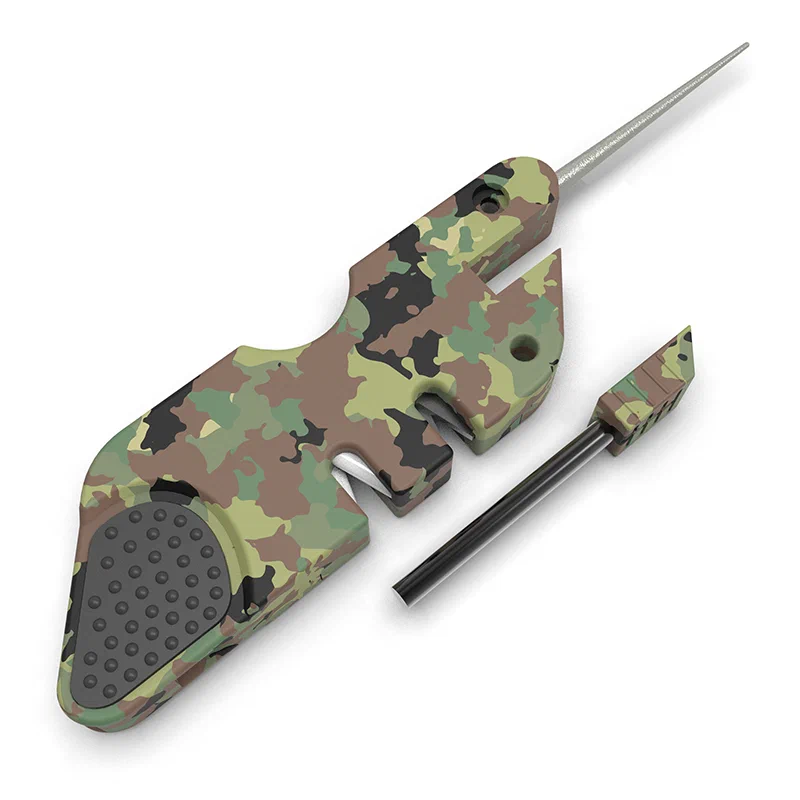
For brands comparing formats, the 6-in-1 camo survival knife sharpener combines all three abrasives in a 30 g body, which is the configuration most outdoor buyers eventually land on.
Integrated Multi-Tool vs Separate Gear: Cost, Loss Rate, Retail Appeal
The 6-in-1 sharpener vs separate fire starter and whistle question is really a question about shrinkage and shelf presence.
Separate gear means three SKUs, three packaging costs and three barcodes. It also means three ways for a customer to lose a component in the field — and lost components generate the support tickets and one-star reviews that damage an outdoor brand faster than a dull edge. Integrated units cut the loose-item count from three to one and reduce packaging SKU count accordingly, which simplifies both retail planograms and e-commerce variant listings.
The counter-argument is margin. In premium tactical channels, a separate ferrocerium rod and a machined aluminum whistle can each carry a higher perceived value than a combined tool, and some buyers deliberately split the kit to raise average order value. That strategy works above roughly $60 retail; below it, shoppers compare on utility per dollar and the integrated version wins.
Physical size drives the packaging decision. At 4.5" x 1.625" x 0.5" (11.4 cm x 4.1 cm x 1.3 cm), the unit sits flat on a standard 4" x 7" hanging card with room for the lanyard hole and a whistle cutout. Anything above 5" long forces a larger blister and adds roughly 8-12% to packaging cost per unit at 10,000 pieces.
Spec Sheet Checklist: Dimensions, Weight, Lanyard Hole, Materials
Put these lines in your purchase spec and hold the factory to them, batch by batch.
| Parameter | Specification |
|---|---|
| Dimensions | 11.4 cm x 4.1 cm x 1.3 cm (4.5" x 1.625" x 0.5") |
| Weight | 30 g |
| Housing material | ABS |
| Abrasives | Carbide, ceramic, diamond |
| Certificates | CE, RoHS |
Lanyard hole diameter matters more than most buyers expect. A 4-5 mm bore accepts 550 paracord and most 2 mm accessory cord; anything under 3.5 mm limits the user to thin lanyard and invites breakage complaints. Specify the hole diameter and the edge radius — a sharp internal edge will fray cord within weeks.
Material declaration is where CE and RoHS work actually happens. RoHS restricts lead, cadmium, mercury, hexavalent chromium, PBB and PBDE; the carbide inserts and any plated hardware are the usual risk points, not the ABS. Ask for a per-batch material declaration and a test report from a recognized lab, and confirm the report covers the exact alloy and coating used in your production run rather than a generic family listing.
Field performance claims need test conditions attached. Salt-spray exposure, a 24-hour freshwater soak, and a -10°C function test cover the three failure modes outdoor buyers ask about. Request the test protocol, not just a pass/fail line.
Sourcing Questions for OEM Buyers: MOQ, Customization, Certification
MOQ and trial orders. Standard MOQ on this format runs 1,000 pieces per colorway, with a 500-piece trial order available at a modest unit premium. Trial orders ship in 20-25 days; full production runs land at 30-35 days after artwork approval. If your launch calendar is tight, book the trial slot first and scale after sell-through data, not before.
Customization. Camo pattern printing, brand LOGO on the housing, and private-label packaging are all viable from 1,000 units. Camo is typically a pad-print or water-transfer film; both hold up to abrasion better than a sticker. LOGO on the ABS body should be specified as an in-mold or pad-print process — ask for a wear test on the print before approving.
Certification paperwork. CE and RoHS documents ship with each batch, and we retain the test reports tied to the specific material lots used. If your market requires REACH or California Prop 65 declarations, flag it at RFQ stage; retrofitting documentation after production is slow and expensive.
Sampling. Expect 7-10 days for a functional sample with your LOGO, and 15-18 days if a new camo film or custom housing color is involved. Samples carry the production abrasive specification, not a bench-built unit — insist on this, because a hand-assembled sample will not reveal the angle variance you will see at 10,000 pieces.
For buyers also sourcing adjacent formats, our outdoor sharpeners category covers field and camp models, while tactical sharpeners lists compact units built for duty and EDC use.
Where to Go Next: Categories and Product Pages
If your range includes both camp and duty knives, browse the full outdoor sharpeners and tactical sharpeners ranges to compare housing sizes, abrasive configurations and packaging formats side by side.
Send your blade inventory — geometry, blade length and target market — to our team and we will return a recommended abrasive configuration, MOQ tier and packaging option with a quotation. Contact us to get a quote.